

BOGO! Buy one, get one free! Who doesn’t love a bonus—except when the bonus is lymphedema. For many of us with inflammatory breast cancer (IBC), lymphedema (LE) becomes the unwelcome “extra,” a lifelong condition without a cure. Not exactly a great deal.
Twelve years ago, during my IBC treatment, LE was mentioned almost as an afterthought. I was told to avoid heavy lifting, skip blood pressure checks and needles on the affected arm, and sometimes wear a sleeve when flying or working out. I did all of it.
Early on, I noticed my left arm was slightly larger than my right—and maybe my left leg, too. I also had a sensitive spot on my forearm where chemo had once leaked before I got a port. That area would turn pink and swell occasionally. I wore fun LympheDiva sleeves that made people at the gym think I was sporting tattoos. For a while, things stayed relatively stable.
Four years later, I joined a rowing group for women treated for breast cancer. When we moved indoors and practiced a technique called feathering, I felt soreness at that old chemo-leak spot. Soon after, I realized a blouse I’d bought just a month earlier was suddenly too tight on my upper arm. Even my husband noticed. After ruling out a blood clot, physical therapy helped somewhat, but not dramatically.
A few months later, catching a side view of my arm, I was shocked by the size. I returned to wearing sleeves more regularly, elevating, massaging, and following all the recommended routines. Some workouts improved flow, but not enough. I lived in this steady state for six or seven years—with occasional bouts of cellulitis, another risk of LE.
By 2024, during fitness classes in front of a mirror, I noticed the arm was getting bigger again. Sleeves were tighter. Even short sleeves felt constricting. A rowing friend who had undergone LE surgery suggested I meet her team in Boston. I waited until retirement so I could manage the many appointments.
A Closer Look
In October 2024, I began the evaluation process and learned:
- My affected arm was now 33% larger than the other.
- My styling LympheDiva sleeves weren’t providing adequate compression compared to brands like JOBST.
- Even with treatment, I might need to wear a sleeve for my lifetime.
- Advanced imaging allowed precise evaluation.
- Lymph fluid that doesn’t drain eventually turns into fat, for reasons still unknown.
- Much of the size difference was fat, not fluid.
Comprehensive imaging—nuclear medicine, MRI, and lymphatic mapping—confirmed the full picture.
The recommendation: debulking (liposuction). I like to joke that the only implant I’ve had was dental and now lipo, but for my arm. But I’m not bitter 😊
Post-surgery, the protocol is wearing a compression sleeve 24/7 (except for showering) for a year. After that, imaging will determine if I’m a candidate for a bypass or node transfer. Fingers crossed I’m on Team Bypass—minimally invasive for the win.
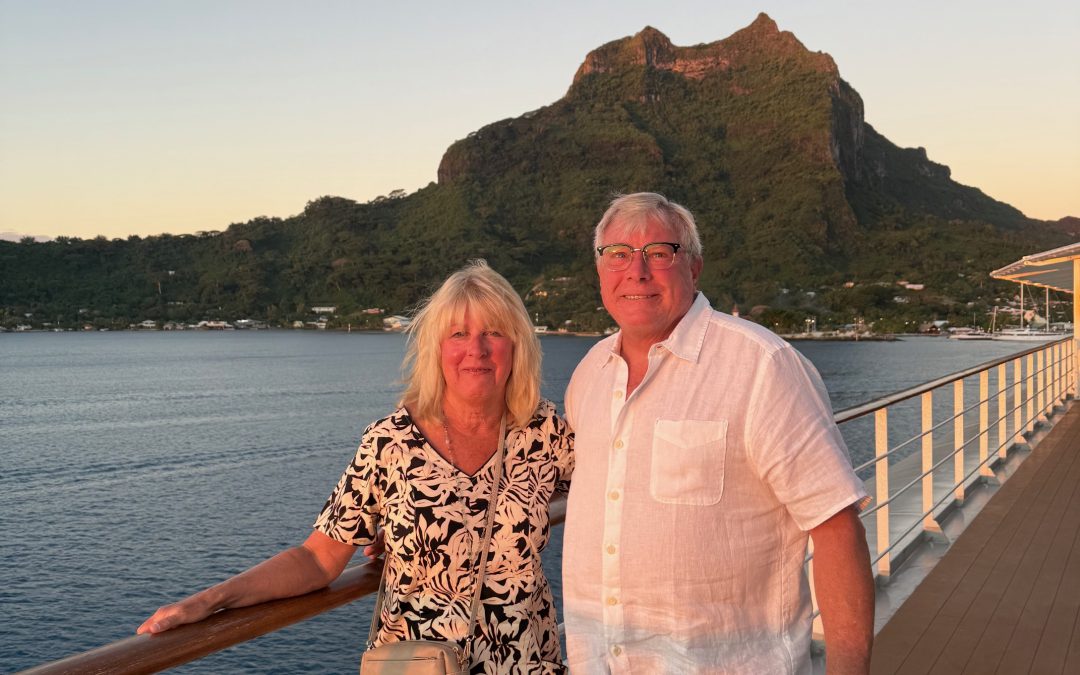
I scheduled surgery for late October to avoid adjusting to full-time sleeve-wearing in the heat. Before starting this new chapter, we finally took our dream trip to French Polynesia. (Yes, I strategically hid my arm in photos.)


After Surgery
A month after surgery—with more than 30 incisions and over three pounds of fat and fluid removed—the change is dramatic. The size reduction makes up for wearing the sleeve (and glove) around the clock. I am healing well. There’s some nerve-regeneration pain, but it’s manageable. I’m adjusting to the daily process of putting the sleeve on and losing the habit to hide my arm in photos. I’m also noticing slight slimming through my abdomen from improved lymph flow. Also, the arm is so much lighter when I lift it!
A surprising bonus: that old chemo-leak spot that had ached for years no longer hurts. I suspect it was removed along with the fat.
Given LE’s progression and past cellulitis episodes, I felt I had no choice but to have surgery. Over the months before surgery, I would remind myself of this. I’m deeply grateful for excellent providers and am taking it one day at a time. I also share with other patients that LE progression is not always linear—early vigilance is key. Many assume that if LE doesn’t appear in the first year or two, they’re fine. That’s not always the case.
I once heard Kathy Bates speak at an LE symposium. Her friends and family thought as long as she beat the cancer, LE was just a small side effect, because they didn’t have to live with it. LE is a whole separate disease, one without a cure… yet. Like with IBC, researchers and clinicians are working to improve outcomes.
And that gives me real hope.